Let’s be real. That moment when you get the quote for a genuine Liebherr part… it stings. Your budget screams for an alternative, and Chinese-manufactured tower crane parts are sitting right there, promising massive savings. The big, nagging question is: Can Chinese tower crane parts really replace Liebherr parts? Are they a smart swap, or a shortcut to trouble?
- Yes, some parts are “replaceable.”
- NO ,Some parts are “dangerous to experiment with.”
In 2026, the answer isn’t a simple yes or no. It’s a strategic decision. Chinese parts are no longer just cheap knock-offs; they are a serious, mature segment of the market. The real challenge is knowing when, what, and from whom to buy. Let’s break down the honest truth.
In 2026, Can Chinese Tower Crane Parts Replace Liebherr?
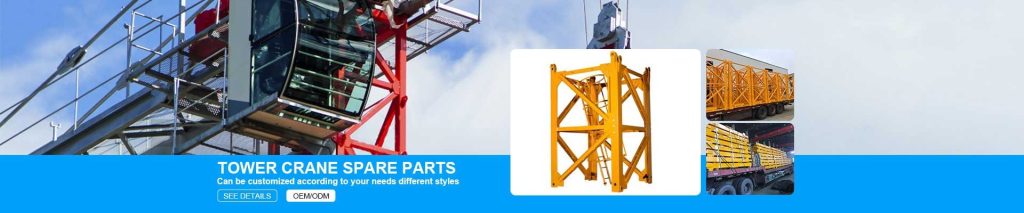
Performance & Matching: “Almost the Same” or “Worlds Apart”?
Let’s start with the big one—performance.
We all know Liebherr is the gold standard; their parts are precision-built for extreme conditions (think freezing winters or scorching deserts) and calibrated to work seamlessly with their cranes’ systems, delivering millimeter-perfect lifts.
“Short answer: Basic parts = almost the same. Critical, high-stress parts = still a gap (but not as big as it used to be).”
But here’s what most people don’t tell you: Chinese manufacturers (like Zoomlion and Sany) have stepped up their game huge in the last 5 years. For basic, non-critical parts—things like steel cables, pulleys, minor hydraulic hoses, or simple electrical sensors—they’re almost identical to Liebherr. These parts don’t affect the crane’s core performance, and top Chinese brands now use high-quality materials (like Q345B steel, the same as many Liebherr components) that match Liebherr’s strength specs. A crane operator in Berlin told me he’s used Chinese cables on his Liebherr 130 for 2 years, and there’s zero difference in lifting smoothness or strength.
The gap shows up with critical components: hydraulic pumps, main engines, control modules, or the specialized fibre ropes Liebherr developed (which boost lifting capacity by up to 38% and last longer than steel alternatives). Liebherr builds these in-house, so they’re perfectly synced with their cranes’ closed-loop control systems—something most Chinese parts still can’t match.
Compatibility & Installation: Plug-and-Play or an Engineering Project?
Compatibility & Installation: Direct Swap or a “Renovation Project”?
Nothing’s more frustrating than ordering a “compatible” part only to find out it doesn’t fit—or worse, that you need to modify your crane to make it work (hello, wasted time and money).
“Mechanical parts are often easier to match.
Electrical and control components are not.”
For older Liebherr models (pre-2015), most Chinese parts are a direct swap. Manufacturers reverse-engineer Liebherr’s standard dimensions (like mast sections, which are often 1.6×1.6x3m for models like the Liebherr 132 HC) to ensure they fit perfectly, no modifications needed
For newer Liebherr models (2018+), it’s a different story. Liebherr has started using more proprietary designs (like their Litronic control systems) to protect their technology. Even if a Chinese part fits physically, it might not sync with the crane’s software—you’ll get error codes, or it won’t work at all.
Service Life: 1 Year or 3 Years (or Longer)?
Liebherr parts are built to outlast: With proper maintenance(recommended 50-hour, 500-hour, and 1000-hour checkpoints), their hydraulic systems hit 20,000+ hours, steel components last 5-7 years, and their specialized fibre ropes last longer than traditional steel ropes. For basic parts (cables, pulleys), Liebherr’s last 4-5 years on average.
“ Basic Chinese parts = 2-3 years. Critical Chinese parts = 1-3 years. Liebherr parts = 2-3x longer (on average).”
Chinese parts? It depends on the part and the brand:
- Basic parts (cables, pulleys, minor hoses): 2-3 years (70-80% of Liebherr’s lifespan) if you maintain them properly. A good Chinese cable might last 3 years, vs. 4-5 for Liebherr.
- Critical parts (hydraulic pumps, control modules): 1-3 years (50-60% of Liebherr’s lifespan). A Liebherr hydraulic pump might last 7-10 years; a Chinese one could last 3-5 years (if you’re lucky).
Cost Gap: Where Does the Saved Money Go?
Let’s be honest—cost is why most people consider Chinese parts. The savings are real, but they’re not as straightforward as you might think.
Chinese parts cut those costs, but The “saved money” often goes toward more frequent replacements. For example: A Liebherr hydraulic pump costs $6,000 and lasts 10 years; a Chinese one costs $2,500 but only lasts 5 years. Over 10 years, you spend $5,000 on Chinese pumps (saving $1,000) but lose time replacing it twice.
“Smart Move: Use Chinese parts for basic components (where savings are big and replacement is easy) to keep costs down—don’t risk critical parts just to save a few bucks.”
Chinese vs Liebherr Tower Crane Parts: What Can Be Replaced — and What Shouldn’t
This is the question you’re really here for—let’s break it down clearly, no confusion. I’ve based this on real-world feedback from construction teams and supplier specs so that you can trust it:
Usually Safe to Replace with Chinese Parts
“Low Risk – Cost-Effective and Technically Feasible”
If a component does not directly control load, movement, or safety logic, it is usually replaceable with qualified Chinese parts. These parts are non-critical, easy to inspect, and weakly integrated into Liebherr’s proprietary systems.
| Category | Typical Parts | Why Replacement Works | Risk Level |
| Structural (Non-Critical) | Mast sections (non-core load zones), secondary jib sections, platforms, ladders, guardrails, brackets, frames | Standardized steel fabrication, mature manufacturing processes, easy dimensional verification | Low |
| Standard Mechanical Parts | Rollers, pins, bolts, sheaves, trolley wheels, bushings | Simple mechanical functions, minimal system interaction, easy testing | Low |
| Consumables & Wear Parts | Wire ropes (certified), mid-grade bearings, seals, rubber components | Standardized steel fabrication, mature manufacturing processes, and easy dimensional verification | Low |
| Steel Cables & Pulleys | Standard lifting cables and pulleys (excluding Liebherr fiber ropes) | Comparable strength specs, predictable wear patterns | Low–Medium |
| Minor Hydraulic Components | Non-critical hydraulic hoses | No impact on core lifting or safety systems | Low |
| Basic Electrical Sensors | High replacement frequency, standardized specs, and easy quality control | Limited software dependency, standard signal protocols | Medium |
| Mounting Hardware | Bolts, nuts, pins, connectors | Fully standardized components, negligible system impact | Very Low |
Replaceable, But With Caution
“Medium to High Risk – Requires Engineering Evaluation”
These parts affect crane dynamics, load behavior, or system stability. Replacement is possible, but only with strict testing and limited application. Many companies adopt a hybrid strategy: Chinese parts + strict testing + limited operational scope
| Category | Typical Parts | Why Risk Exists | Risk Level |
| Power & Motion Systems | Hoist motors, gearboxes, brakes, slew drives | Directly influence lifting behavior and crane stability | Medium–High |
| Core Structural Components | High-load mast sections, critical jib joints, counter-jib structures | Load-bearing role in primary structural system | High |
| Electrical & Drive Systems | Frequency converters, limit switches, advanced sensors | Require system-level compatibility and calibration | Medium–High |
| Hydraulic Systems (Core) | Pumps, valves, cylinders | Precision and response speed affect safety and performance | High |
Strongly Recommended to Keep Liebherr
“High Risk – Safety-Critical and System-Integrated”
These components are deeply integrated into Liebherr’s engineering, software, and safety architecture. Replacement with non-original parts significantly increases operational and legal risk.
| Category | Typical Parts | Why Liebherr Must Be Used | Risk Level |
| Core Safety Systems | PLC control systems, load moment indicators (LMI), safety logic units, emergency braking systems | Integrated safety architecture, certified algorithms, regulatory compliance | Very High |
| High-Risk Mechanical Systems | Main slew bearings, hoist brake systems, critical load paths | Failure leads to catastrophic accidents | Very High |
| Software & Proprietary Systems | Control software, integrated safety algorithms, Liebherr Litronic systems | Proprietary architecture, impossible to replicate | Very High |
| Specialized Technologies | Integrated safety architecture, certified algorithms, and regulatory compliance | Unique performance and certification standards | Very High |