If you’re in the crane game—whether you run a construction crew, manage a fleet, or handle maintenance—you know the struggle. You go to replace a simple filter or a worn-out seal for your European crane (think Liebherr, Manitowoc, Terex), and bam—your wallet’s screaming. It’s not just you wondering, “You’ve ever shouted, Why are European crane parts so expensive? on your screen,
Why are European crane parts so expensive?
- The R&D Tax: Those brands spent decades and millions developing the technology, safety standards, and certifications (hello, CE mark). A slice of that historic investment is baked into every single bolt and sensor.
- Localized Costs: Manufacturing in Europe means European labor rates, benefits, and operational expenses. That quality has a real, upfront price tag.
- The Supply Chain Markup: The part often doesn’t go straight from the factory to you. It might travel through a national distributor, then a regional dealer, each adding their layer of margin for inventory and support.
- The “Peace of Mind” Premium: A significant part of the price is for the brand’s guarantee, their technical support hotline, and the promise that this part will work perfectly. You’re buying certainty as much as steel.
- The Monopoly Effect: For proprietary parts on specific models, they are the only game in town. They control the supply, and therefore, the price.
- Brand and OEM premium: Major OEM brands like Liebherr, Demag, Konecranes, and Manitowoc don’t just sell parts—they sell ecosystems.
“You’re funding an entire ecosystem of past innovation and present-day security. But is that premium necessary for every single component on your crane? Often, no.”
The Big Question: Are Chinese Replacement Parts a Risky Move?
When I first suggested swapping European parts for Chinese ones, my team thought I was crazy. “Won’t that break the crane?” “Will we lose the OEM warranty?” “Is the quality garbage?” I get it—those fears are real. But after testing Chinese parts for 5 years (and saving my company $100k+ in maintenance costs), I can tell you: most of those fears are unfounded.
“Chinese crane parts can be reliable—but not all of them are.China vs Europe.” The risk is “good supplier vs bad supplier”
Is the quality of Chinese crane parts reliable?
Here’s the truth: it depends on where you buy them. There are definitely cheap, junk Chinese parts out there—just like there are junk parts from any country. But the good Chinese manufacturers? They’re stepping up their game big time. like CPTC(Chongqing Clipper Industrial Co., Ltd.) —they use the same high-strength materials as European brands, have CE and ISO certifications, and run the same quality checks. For standard parts (filters, seals, bearings), Chinese parts last just as long as European ones—sometimes longer.
Will Chinese parts affect the safety of my crane?
Safety is non-negotiable—period. The good news? As long as you pick the right parts, Chinese alternatives won’t put your crane (or your crew) at risk. Crane safety comes down to two things: matching the part’s specs to your crane, and using quality components. For non-core parts (filters, brake pads, wire ropes), Chinese parts meet the same strength and safety standards as European ones—they just cost less.
For core parts (main reducers, hydraulic pumps), you have to be pickier. Stick to Chinese brands that specialize in heavy equipment parts and have OSHA and CE certifications.
| Part Category | Safety Impact | Suitability for China Sourcing |
| Structural steel components | Very high | Not recommended |
| Main braking systems | Very high | Not recommended |
| Motors and gearboxes | Medium | Possible with strict technical matching |
| Electrical accessories | Low | Highly suitable |
| Wear parts | Low | Highly suitable |
| Standard mechanical parts | Low | Highly suitable |
Will I lose the OEM warranty if I use Chinese parts?
| Type of Part | Will It Void the Warranty? | Key Tip |
| Wearing parts (filters, seals, brake pads) | Almost never | OEMs don’t expect you to use their overpriced filters—just keep receipts in case of questions |
| Non-core parts (joysticks, travel motors) | Only if the part causes damage | Buy certified parts—if the part fails and damages the crane, the Chinese supplier (not you) should cover it |
| Core parts (main reducer, main pump) | Possibly—check your warranty | Call the OEM first! Many will let you use certified non-OEM parts without voiding the warranty |
Which Crane Parts Actually Make Sense to Source from China?
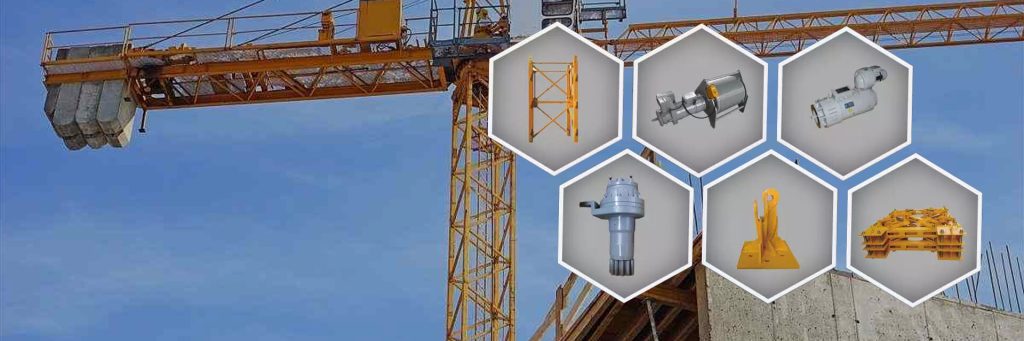
Parts That Are Generally Safe to Source from China: Low risk, high cost efficiency
These components are standardized, widely used, and relatively easy to control in terms of quality and performance.
| Category | Typical Crane Parts | Why They Work Well from China |
| Standard & wear parts | Wire ropes, bearings, brake pads, seals, gaskets, filters, rubber components | High standardization, mature manufacturing, frequent replacement makes OEM pricing hard to justify |
| Electrical accessories | Hydraulic hoses, fittings, auxiliary valves, and non-core cylinders | Non-proprietary designs, clear technical specs, easy compatibility verification |
| Hydraulic accessories | Hydraulic hoses, fittings, auxiliary valves, non-core cylinders | Technical requirements are measurable and controllable through testing |
| Standard mechanical parts | Bolts & nuts, couplings, chains, standard gears | Global industrial standards, minimal OEM dependency |
| Auxiliary & non-load-bearing items | Ladders, platforms, walkway gratings, handrails, lighting, signal devices | Limited impact on structural safety, easy quality inspection |
Parts That Should Usually Be Purchased from OEM: High safety impact or proprietary design
These components are deeply integrated into the crane’s core systems and directly affect safety, certification, or system stability.
| Category | Typical Crane Parts | Why OEM Is Recommended |
| Proprietary modules | OEM control modules, brand-specific PLC systems, software-driven components | Patented design, system-level integration, OEM software compatibility |
| Core drive systems | Main hoist gearboxes, slewing drives, long travel gearboxes | High engineering complexity, catastrophic risk if mismatched |
| Structural components | Main girders, end trucks, forged pins, load-bearing steel structures | Direct impact on structural integrity and certification |
| Core safety systems | Main braking systems, overload protection systems, certified load cells, LMI systems | Failure could lead to severe accidents |
| Certified safety electronics | Safety PLCs, certified sensors, emergency stop systems | Compliance with CE/EN standards depends on OEM configuration |
Parts That Can Be Sourced from China, But with Caution: Medium risk, requires engineering-level verification
These components can be replaced, but only when specifications, certifications, and compatibility are rigorously validated.
| Category | Typical Crane Parts | Risk Level | Key Risks & What to Check |
| Motors & gearboxes | Auxiliary motors, secondary gearboxes | Medium | Match power, torque, RPM, frame size, insulation class, IP rating |
| Brake components | Auxiliary brake pads and discs | Medium | Material grade, friction coefficient, heat resistance, OEM experience |
| Wire ropes & slings | Lifting ropes, slings | Medium–High | Full traceability, test certificates, breaking force standards |
| Control components | PLC modules, frequency inverters, load limiters | Medium | Software compatibility, communication protocols, CE/EN certification |
| Precision hydraulic parts | Pumps, main valves | Medium–High | Pressure rating, response time, material quality, fatigue life |
| Conductor systems | Collector shoes, insulators | Medium | Electrical insulation performance, wear resistance |