In the world of engineering thermoplastic injection molding, Polyamide 6 (PA6) and Polyamide 66 (PA66) are two of the most widely specified resins. Although both belong to the semi-crystalline polyamide family, their melting points, crystallization rates, melt fluidities, and shrinkage characteristics differ significantly. On the shop floor, these two materials behave like completely different beasts. Choosing the wrong grade or setting improper machine parameters can lead to costly tool modifications, severe part warpage, or premature structural failure in the field.
| Feature / Metric | Polyamide 6 (PA6) | Polyamide 66 (PA66) |
| Processing Melt Temp | 230℃ – 260℃ (Wide window, easy processing) | 280℃-310℃ (Narrow window, degradation-prone) |
| Recommended Mold Temp | 70℃-90℃ | 80℃-100℃ (Crucial for full crystallization) |
| Melt Viscosity & Flashing | Moderate viscosity, low flash risk | Water-like low viscosity; flashes at >0.02 mm gaps |
| Cycle Time | Standard | 15%-25% Shorter (Fast crystallization & ejection) |
| Mold Shrinkage Rate | 1.0%-1.5% (Dimensionally stable) | 1.5%-2.5% (High anisotropy, higher warpage risk) |
| Surface Finish | Smooth, high gloss, no flow lines | Average aesthetics; flow lines common |
| Key Advantage | High toughness, easy processing, lower raw material cost (10% – 20%lower) | High heat deflection (HDT), superior wear resistance, high productivity |
Polyamide 6 (PA6): Forgiving Processability, Excellent Toughness & Aesthetics
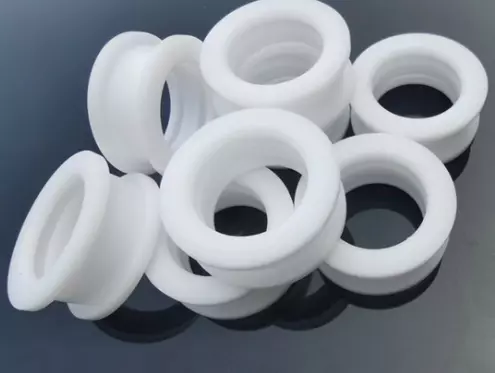
Core Positioning: The go-to choice when balancing high impact toughness, superior surface finish, and cost-efficiency.
Typical Applications
Power tool housings, mechanical handles, exposed aesthetic panels, automotive interior/exterior trim, and general structural hardware.
Melt Temperature & Processing Window:PA6 has a lower melting point (220℃ – 260℃) and a broad processing window. A temperature variation of ±10℃ is unlikely to degrade the polymer or cause nozzle drooling, making setup forgiving for technicians.
Mold Temperature Setup
The recommended mold temperature is 70℃-90℃ (operating range: 60℃-100℃). Maintaining a higher mold temperature promotes uniform crystallization and enhances surface gloss.
Surface Aesthetics
The melt fills the cavity smoothly, producing parts with excellent surface finish and virtually no flow marks or splay. It is ideal for “cosmetic components” where visual appearance is critical.
Flash Control & Shrinkage
PA6 maintains a moderate melt viscosity and is far less prone to flashing (burrs) than PA66, placing fewer demands on mold parting-line precision and clamping force. Mold shrinkage is relatively low (1.0% – 1.5%) with minimal anisotropy, making strict dimensional tolerances easier to achieve in standard geometries.
Post-Molding Moisture Absorption
In ambient application environments, PA6 absorbs moisture faster than PA66. Upon reaching moisture equilibrium, PA6 exhibits a more pronounced increase in impact ductility along with slight dimensional changes.
Polyamide 66 (PA66): High Thermal Resistance, Rapid Cycles & Extreme Flash Sensitivity
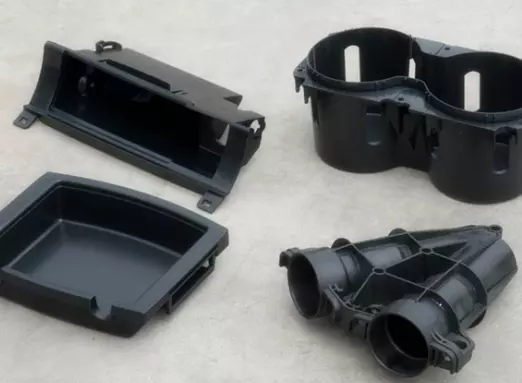
Core Positioning: The heavy-duty choice for high continuous heat resistance, wear resistance, and high-volume output.
Typical Applications: Engine bay structural brackets, industrial gears, wear-resistant bushings, and high-temperature coil bobbins.
Melt Temperature & Thermal Degradation Risk
PA66 features a high melting point (260℃ – 290℃), requiring barrel temperatures strictly calibrated between 280℃-310℃. PA66 is heat-sensitive; excessive barrel residence time leads to yellowing and thermal degradation. At elevated temperatures, its low viscosity causes severe nozzle drooling.
Mold Temperature Requirements
Recommended mold temperature is $80℃- 100℃ (operating range 80℃-110℃) If the mold temperature is too cold, the material cannot fully crystallize inside the cavity, leading to post-molding secondary shrinkage and dimensional distortion at room temperature over time.
Extreme Propensity for Flashing
In a molten state, PA66 exhibits extremely low viscosity (it flows like water). If the mold parting line has a gap as small as 0.02 mm or if machine clamping force is insufficient, PA66 will immediately flash, incurring high manual deflashing costs.
High Production Efficiency (Shorter Cycle Times)
PA66 molecules crystallize rapidly, allowing the melt to freeze quickly upon entering the mold. For standard wall thicknesses, PA66 can achieve a 15% – 25% shorter cycle time compared to PA6, making it optimal for large-scale production runs.
Warpage & Equipment Wear
Unfilled PA66 exhibits higher shrinkage (1.5% – 2.5%) with strong anisotropy (the difference between flow and transverse flow shrinkage is significant), making flat parts prone to warpage. Furthermore, prolonged processing at high temperatures accelerates screw and check-ring wear, requiring dedicated feed throat cooling and anti-drool nozzle tips.
Shop Floor Troubleshooting & Pitfall Avoidance
1. Desiccant Drying is Mandatory (Preventing Splay, Voids & Hydrolysis)
Nylons are notoriously hygroscopic. Prior to processing, both PA6 and PA66 must be dried in a desiccant dryer (standard hot-air hoppers are ineffective for deep moisture removal) at 100℃ for at least 4 hours, keeping moisture content below 0.1% (ideally <0.08%). Excess moisture causes hydrolytic polymer chain breakdown, surface splay, and severe brittleness.
2. Snap-Fit Protection: Post-Molding Conditioning (Moisture Pick-Up)
Nylon components straight out of the mold are in an ultra-dry, highly stressed state and are extremely brittle. Attempting to assemble snap-fits immediately will result in premature snapping.
Field Solution: Submerge freshly molded snap-fit or thin-walled parts in hot water at 70℃ – 80℃ for 2 to 4 hours (or place them in a humidity conditioning chamber). This accelerates moisture absorption to equilibrium, dramatically boosting impact toughness and flexibility.
3. Mitigating Warpage in Glass-Reinforced Grades (GF30)
Adding glass fiber (e.g., PA6-GF30 or PA66-GF30) doubles mechanical strength but introduces severe differential shrinkage along the fiber orientation. For large flat components, in addition to optimizing gate placement, parts should be transferred into cooling fixtures/jigs immediately upon ejection to prevent bow warpage as they cool.
Selection Rules of Thumb
Choose PA6 if: The component does not encounter continuous high temperatures, requires high surface aesthetic quality, is budget-sensitive, or demands high impact energy absorption.
Choose PA66 if: The part is installed near engine compartments or high-heat environments, functions as a heavy-load gear or wear bushing, or requires maximum output efficiency in high-volume production.