A suspension scaffold that uses two points of support is called a two-point adjustable suspension scaffold (commonly known as a swing-stage scaffold). It consists of a platform supported by stirrups or hangers at each end, suspended from overhead supports by two ropes or cables. They are usually equipped with adjustable hoists used to raise or lower the platform. They are widely used for high-rise building construction, exterior maintenance, window washing, painting, and masonry work.
According to OSHA (Occupational Safety and Health Administration) regulations, workers on a two-point adjustable suspension scaffold are typically required to use both guardrail systems and personal fall arrest systems.
Two-Point Suspension Scaffold: Key Features
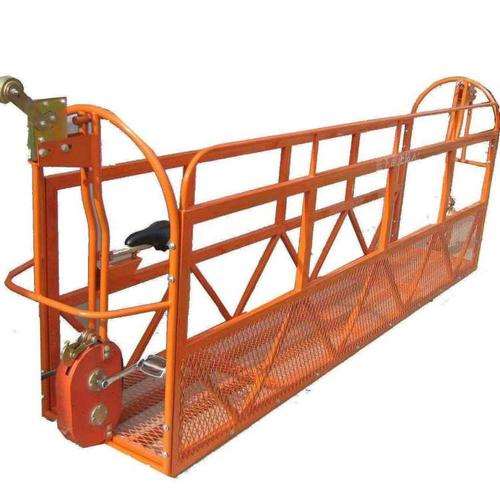
- Structure: Consists of a platform supported by stirrups at each end, hung from overhead supports by two ropes or cables (hence “two-point”).
- Adjustability: Equipped with hoists (manual or powered) that allow workers to raise or lower the platform to different levels.
- Common Uses: The most common type of suspended scaffold, utilized for high-rise construction, exterior maintenance, window cleaning, painting, and masonry.
- Safety Requirements: Because they are elevated, safety regulations require standard guardrails on the platform and personal fall arrest systems (PFAS) for workers.
Main Limitations and Cons
High Wind Sensitivity: Suspended by only two steel ropes without rigid lateral support, it sways severely in high winds, reducing precision and halting work.
Limited Capacity & Space: A light-duty platform restricted to 2–3 workers with hand tools; heavy materials (like bricks or cement) cannot be stacked.
Restricted Mobility: Narrow platforms (45–90 cm wide) limit lateral movement, requiring full roof-rigging shifts to change positions.
Complex Rigging: Strict requirements for roof loads, anchor points, and counterweights require a Competent Person to prevent severe fall risks.
Hoist Types Used in Suspension Scaffolds
Two-point suspension scaffolds do not rely on cranes for daily operations; they are entirely independent suspension and lifting systems. The platform itself features manual or motorized hoists running on wire ropes.
- Crane Relationship: Cranes (like tower cranes or mobile cranes) may occasionally be used during the installation phase to hoist heavy outrigger beams or large materials to the roof. During actual operation, however, the scaffold functions independently. It is secured to the top of the building via roof outrigger beams (with counterweights), parapet clamps, or cornice hooks.
- Hoist Types: The most common modern configuration uses two powered traction hoists mounted at each end of the platform.
| Hoist Type | Operating Principle | Typical Application |
| Manual Traction Hoist | The operator turns a handle; internal gripping pulleys drive the wire rope upward. | Short-duration or low-rise construction where electricity is unavailable. |
| Electric Traction Hoist | An electric motor drives pulleys that grip and travel along the wire rope without spooling it inside. | The most common choice for powered two-point platforms and high-rise work. |
| Pneumatic / Air-Powered Hoist | Compressed air powers the lifting motor and traction mechanism. | Locations where electrical equipment is unsafe or compressed air is readily available. |
| Drum-Type Hoist | The hoist spools the suspension rope onto a drum as the platform ascends. | Specialized systems requiring adequate rope capacity and proper drum winding. |
| Wire-Grab / Tirfor Manual Hoist | A manually operated mechanism grips and pulls the wire rope through the hoist. | Portable, light-duty, or temporary suspended platform applications. |
Core Safety and Operational Requirements
- Dual Fall Protection (Critical): Workers must simultaneously use a standard guardrail system (top rail, midrail, toe board) and a personal fall arrest system (PFAS, such as a harness). Lanyards must be tied off to independent vertical lifelines, never directly to the scaffold structure or suspension lines.
- Load-Bearing Safety Factors: Suspension ropes and connecting hardware must be capable of supporting at least 6 times the maximum intended load. Platforms and structural components must support at least 4 times the maximum intended load.
- Roof Counterweights and Tiebacks: If outrigger beams are used, counterweights must be solid, approved mechanical weights. Loose, flowing materials (such as sand, gravel, or water tanks) are strictly prohibited. Tieback lines must be securely anchored to the building’s structural framework to prevent swaying.
- Pre-Shift Inspection: Before every shift, a Competent Person must thoroughly inspect the wire ropes (checking for broken wires or wear), hoist brakes, electrical systems, and connection points.