Today, a Variable Frequency Drive (VFD) in construction is not only a motor controller but rather the brain of a hoist control system that plays an important role in ensuring the safety and efficiency of a hoist as well as its management features. Below are described its main functions and their importance.
| Function | Why it matters |
| Speed control | Smooth lifting and lowering |
| Torque control | Stable load handling |
| Soft start/stop | Reduces mechanical stress |
| Braking control | Improves safety |
| Programmable logic | Enables advanced control features |
Why VFDs Are Essential & Matter for Control Systems for Construction Hoists?
An elevator uses an electric motor as a means of lifting the load, but due to lack of VFD, there is difficulty in handling its rapid acceleration/deceleration and poor load adaptability. This problem is solved using VFD technology, which makes the system intelligent.
Without the VFD technology, a construction hoist is just ordinary machinery. With the VFD, it is made into a smart system. With additional features such as remote accessibility, automation logic, and usage control capabilities, it goes beyond being mere engineering tools and becomes a business infrastructure.
The traditional DOL starting method results in mechanical shock and poor load adaptation due to non-controllable current flow. VFD enables the system to achieve a transition from “extensive drive” to “precise control,” through its ability to manipulate the voltage and frequency. The comparisons include the following:
| Dimension | Traditional Control | VFD Control | Benefits |
| Operation Smoothness | Abrupt start/stop, severe jitter | Soft Start/Stop | Improves passenger comfort and protects mechanical structure |
| Load Response | Fixed speed, vulnerable to heavy load impact | Dynamic Torque Compensation | Extends the service life of motor and gearbox |
| Mechanical Loss | High starting current, rapid mechanical wear | Reduces inrush current and wear | Extends the service life of the motor and gearbox |
| Safety | Relies on mechanical braking, high risk | Dual protection of electrical + mechanical braking | Significantly enhances braking safety |
How to Reduce Bad Debt in Equipment Rental: The Power of the VEICHI Inverter for Construction Hoist
How VFD Works in a Construction Hoist?
In general, the main principle of operation for a VFD includes 4 basic processes in which the speed of a motor is determined by the frequency, as follows: High frequency results in a fast-rotating motor; low frequency means a slow-rotating motor. The main operating principle of VFD is the AC-DC-AC transformation process.
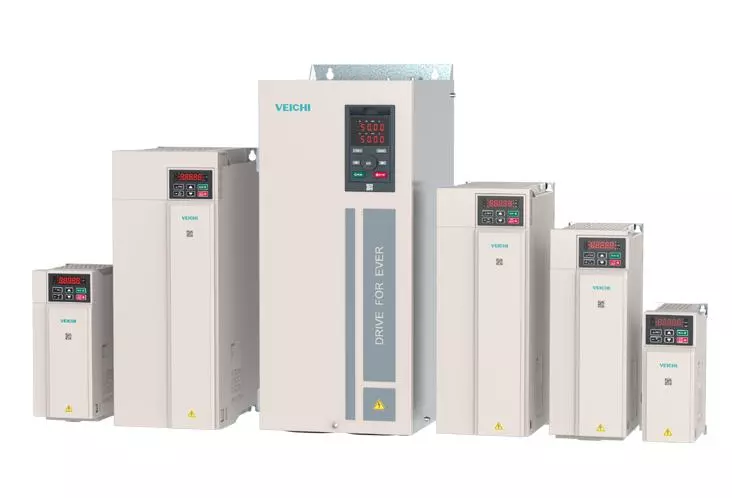
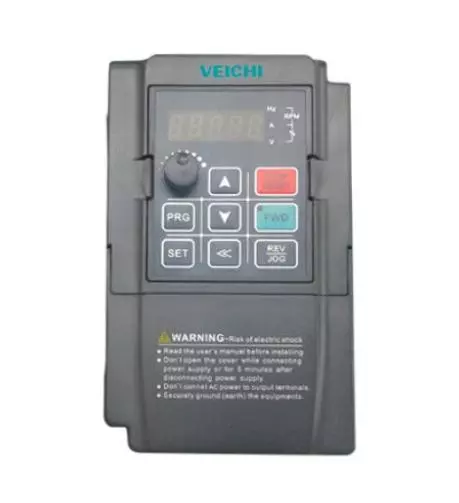
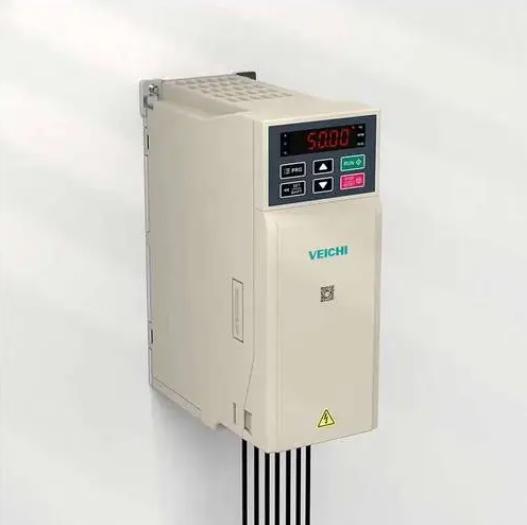
Veichi Inverter
- Innovation and efficiency;
- Green and environmentally friendly;
- Customized services.
1. Four Key Operating Stages
- Rectifier: Changes AC voltage to DC voltage.
- DC Bus: Controls DC voltage through capacitors.
- Inverter: Changes DC voltage to AC voltage with variable frequency.
- Output Control: Regulates motor speed by changing frequency (Hz).
2. Key Technical Pillar: Braking Logic
When it comes to systems such as construction hoists, “stopping” is harder than “moving.” The VFD offers several types of brakes:
- Dynamic Braking: It uses excess energy to avoid sliding.
- Regenerative Braking: This type of brake returns energy to the system and saves energy.
- Load Holding: Electrical torque helps hold the load before the mechanical brakes activate.
3. Extended Functions: Endowing Hoists with “Intelligence.”
The latest generation of VFDs (VEICHI series) can act as a medium to connect IoT and automation. These VFDs do not just control electricity but also information. Using the VFD programmable interface and communication protocol, one could get the following features:
- Intelligent Diagnosis – real-time fault diagnosis, such as overload and undervoltage, for preventative maintenance.
- Remote Monitoring – through the IoT module, managers can monitor the working condition on their phone at any time.
- Management Permission Lock – time lock of lease period expiry, identity lock (only authorized personnel can operate the equipment), and billing system integration (integration between working time and operational cost).
Ready to secure your rental revenue? Explore the VEICHI Inverter for Construction Hoist and transform your fleet into a self-protecting asset today.