When assembling or purchasing a CNC router, choosing the right linear drive system is one of the most critical decisions you will make. This mechanism converts the rotary motion of your motors into linear movement, directly dictating your machine’s speed, precision, working envelope, budget, and long-term maintenance costs.
For most CNC router hobbyists and industrial users alike, the final choice boils down to a simple rule of thumb: compact and precise applications demand ball screws, large-format operations require a rack and pinion for maximum efficiency, and premium high-end manufacturing calls for linear motors.
- Rack and Pinion is best suited for long travel spans and large-format machinery.
- Ball Screw is ideal for short travel distances and high-precision applications.
- Linear Motor stands as the premium choice for those pursuing ultimate speed and acceleration.
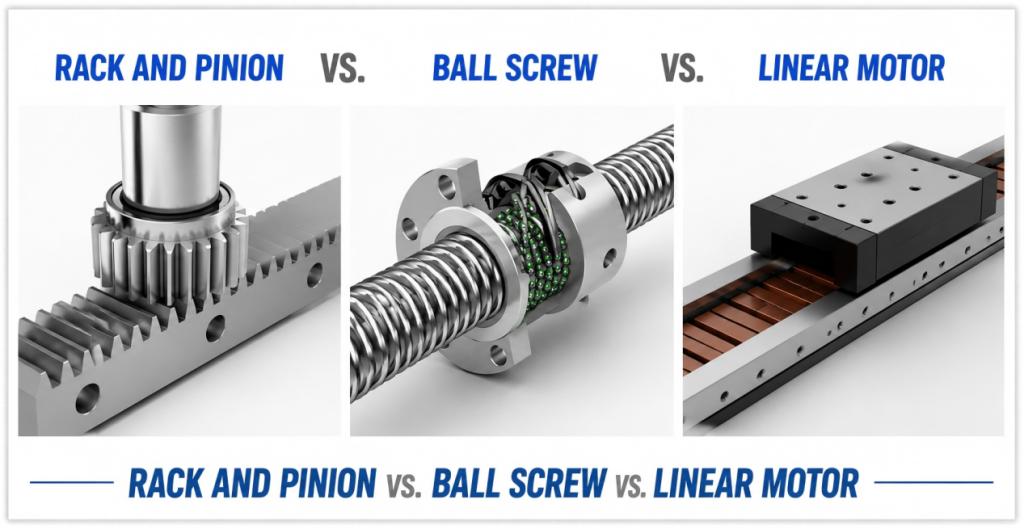
Ball Screw Systems: The Precision Workhorse
A ball screw consists of a threaded sculptural shaft and a nut filled with recirculating ball bearings. As the screw rotates, the bearings roll smoothly within the threads, driving the nut—and your CNC axis—forward.
The Advantage: High positioning accuracy, exceptional repeatability, massive thrust, and high rigidity. Because the rolling ball bearings experience minimal friction, they exhibit virtually zero backlash (slop between mechanical components). This delivers incredible accuracy for intricate detailing and 3D carving. They also excel at handling high vertical loads, making them the default industry standard for Z-axes.
The Limitation: Length restrictions. If a ball screw is too long, it will begin to “whip” or sag when spun at high speeds due to structural resonance. Consequently, their costs spike dramatically with length, and they are rarely used on the long X- or Y-axes of large format machines (e.g., 4×8 feet or larger).
Rack and Pinion: The Large-Format Speedster
A rack-and-pinion system uses a straight, toothed gear track (the rack) paired with a circular gear (the pinion) that meshes with it. As the motor spins the pinion, it crawls along the fixed rack.
The Advantage: Raw speed, infinite scalability, and highly straightforward construction for long-travel setups. Racks can be butt-joined seamlessly end-to-end, making this system the undisputed industrial standard for large routers processing massive sheets of plywood, MDF, or plastics. They handle ambient dust and debris exceptionally well and offer fast rapid travel speeds.
The Limitation: Backlash risk. Standard straight-cut spur gears have small microscopic gaps between teeth. While modern helical rack and pinion configurations minimize this by utilizing angled teeth, they still inherently possess slightly lower resolution and positional accuracy than a well-pretensioned ball screw, requiring precise alignment and regular maintenance.
Linear Motors: The Direct-Drive Revolution
Linear motors discard mechanical conversion altogether. Imagine taking a standard rotary brushless motor, cutting it open, and laying it completely flat. The “stator” becomes a flat track of permanent magnets, and the “rotor” becomes a moving coil assembly that floats directly above it.
The Advantage: Highest acceleration, zero mechanical backlash, and ultra-smooth motion. Because there is absolutely no mechanical contact between the driving elements, there is zero friction and zero mechanical wear. This leads to an incredibly long lifespan and drastically slashes cycle times on complex, high-speed toolpaths.
The Limitation: Extremely high cost and demanding control integration. They require highly advanced closed-loop feedback systems. Furthermore, their intense magnetic tracks aggressively attract steel dust and ferrous shavings, making robust protective shielding and sealing non-negotiable in metalworking environments.
Which One Wins for CNC Routers?
| Feature | Ball Screw | Rack and Pinion | Linear Motor |
| Max Practical Length | Short to medium spans (< 6-8 feet) | Unlimited scalability | Unlimited scalability |
| Precision & Accuracy | Excellent | Good to Very Good | Exceptional |
| Max Speed & Acceleration | Moderate | High | Extreme |
| Backlash Risk | Extremely Low | Moderate (Mitigated by helical teeth) | Zero |
| Maintenance Needs | Regular lubrication of screws/nuts | Low maintenance; requires debris clearing | Extremely Low (No friction components) |
| Cost Component | Moderate | Highly economical for large formats | Very High |
| Best Suited For | Small-to-medium routers, compact precision axes | Large-format CNC routers, gantry machines, long travel | High-end motion systems, ultra-high-speed production |
| Key Advantage | High positioning accuracy, excellent repeatability, high thrust | High speed, scalable length, robust for heavy gantries, simpler long travel build | Maximum acceleration, zero mechanical wear/slop, ultra-smooth motion |
| Key Disadvantage | Unsuitable for long spans due to shaft whip/sag; cost scales poorly with length | Higher backlash than preloaded screws; requires precise alignment | Highest initial cost; complex control and integration demands |
There is no universal winner; the best choice depends entirely on your specific application:
For small routers: Ball screw usually wins. It is simpler to tune for accuracy, provides massive structural thrust, and works flawlessly over shorter spans with highly accessible pricing.
For large wood routers and nesting machines: Rack and pinion wins. It offers the ideal balance of speed, durability, and practicality for long travel, completely eliminating the whip and vibration issues that plague extended ball screws.
For ultra-premium routers or automation platforms: Linear motor wins. It is the ultimate performance leader, but it makes financial sense only when its extreme throughput, lack of mechanical wear, or sub-micron accuracy demands fully justify the massive up-front premium.