The gear rack and pinion drives are the true muscle of heavy machines. This is what makes the power behind massive tower cranes, mining excavators, and even industrial robotic arms and portal gantry systems work.
What makes them so vulnerable is the fact that their operation is done “openly” to the natural conditions, which means that they are exposed to some extremely harsh conditions: loads, shock loads, abrasive dust, water penetration, and temperature extremes. Unless properly lubricated, these devices will fail rapidly.
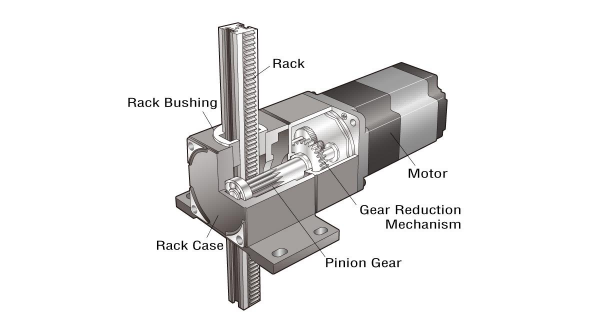
Compared to conventional lubricants, what makes the lubrication requirements for open gear rack and pinion systems so unique?
Conventional gears (such as enclosed gearboxes) and open gears are worlds apart in terms of working environment and lubrication mechanisms. Conventional lubricants need to “flow,” while open gear lubricants must “stick”; conventional lubricants fear impurities, while open gear lubricants must “encapsulate” impurities.
| Characteristic | Enclosed Gearbox Lubrication | Open Gear Rack & Pinion Lubrication |
| Operating Environment | Well-sealed; fully protected against external dust and moisture. | Fully exposed to air, direct dust, water vapor, and environmental contaminants. |
| Lubrication Method | Splash (oil bath) or continuous circulation; gears are repeatedly submerged. | Intermittent manual application or automated spraying; the lubricant must “stay on standby.” |
| Lubrication Regime | Readily forms a complete hydrodynamic fluid film. | Functions in a boundary lubrication regime where the fluid film is prone to rupturing. |
| Material Loss | Oil circulates internally; virtually zero fluid loss. | Highly prone to slinging, flinging, or dripping due to centrifugal and gravitational forces. |
Why do open gears need special lubrication?
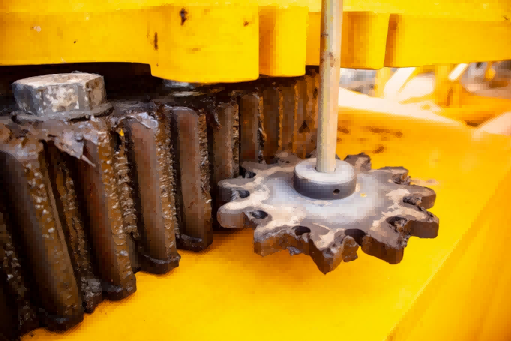
1. Open environment → Must resist flinging and running off
Open racks and pinions are usually installed vertically or at an angle. When the gear rotates at high speeds, centrifugal force will instantly fling away ordinary lubricating oil. A conventional oil film simply doesn’t have the time to form.
2. Low speed and heavy load + sliding → Requires an extremely strong extreme pressure (EP) film
When open gears mesh, there is significant relative sliding between the tooth surfaces. Combined with frequent starts and stops and large shock loads, the contact stress can easily exceed the limits of ordinary anti-wear agents. Only lubricants containing solid lubricants (such as $MoS_2$) or highly active sulfur-phosphorus additives can form a boundary lubrication film with a load-carrying capacity exceeding 2000 MPa.
3. Ingress of dust/sand/stones → Requires high consistency and sealing performance
Conventional thin oil will mix with dust to become a “grinding paste,” quickly wearing out the tooth profiles. In contrast, high-tack open gear grease can encapsulate impurities like “mud,” preventing them from entering the contact zone and forming a physical barrier on the tooth surfaces.
4. Difficult oil supply → Must adapt to long-cycle, low-frequency lubrication
Open racks are often dozens of meters long, making manual lubrication time-consuming and labor-intensive. Therefore, the lubricant must possess extremely long re-lubrication intervals (days or even weeks) and maintain stable performance under low-temperature and humid environments.
Lubrication requirements for open gear rack and pinion
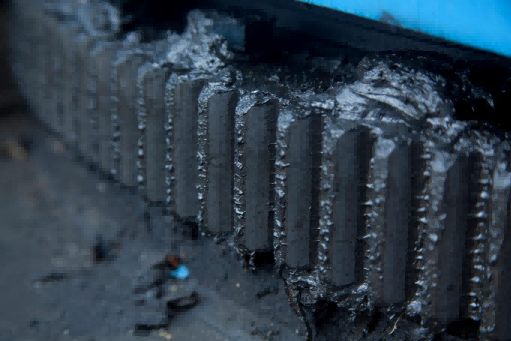
- Extreme Tackiness: The lubricant must stick firmly to the tooth surfaces like glue, resisting both the centrifugal force flinging it off during pinion rotation and the gravitational runoff on vertically installed racks.
- High Base Oil Viscosity: The base oil typically needs to reach ISO VG 460, 1000, or even higher. This extremely high viscosity forces a protective film to be maintained under ultra-heavy loads.
- Excellent Extreme Pressure and Anti-wear Properties (EP Additives): Must contain powerful extreme pressure additives. Usually, solid lubricants (such as graphite, molybdenum disulfide $MoS_2$) need to be added, so that when the oil film ruptures under heavy load impacts, these solid particles can form a physical barrier to prevent tooth surface scuffing/welding.
- Anti-channeling and Self-Healing Capability: When the gear meshing squeezes the lubricant to both sides, the lubricant needs to have a certain flow resilience (self-healing property) to re-cover the tooth surfaces before the next meshing cycle arrives.
- Excellent Environmental Resistance: Must possess extremely strong resistance to water washout and spray, and resist attracting and absorbing dust.
Lubricant Types Comparison and Selection for Open Gear Rack and Pinion Systems
| Lubricant Type | Pros | Cons | Best-Fit Applications | Maintenance Notes |
| Heavy-Duty Open Gear Grease (General Purpose) | Extremely strong tackiness, not easily flung off, good protection, cost-effective. | Highly prone to catching dust to form “grinding paste”; lacks heat dissipation and self-cleaning capabilities. | Medium-to-low speed, heavy-load conventional industrial equipment (such as standard construction hoists, conventional cranes). | Must regularly “scrape off the old and apply the new.” It is strictly forbidden to only add grease without cleaning, which leads to the accumulation of hardened old grease. |
| Open Gear Oil (Spray/Circulation) | Has fluidity, can flush away tiny wear debris and carry away part of the frictional heat. | Easy to drip or splash, causes certain environmental pollution; relies heavily on hardware. | Continuously running, slightly higher-speed large heavy-duty drives (such as ball mills, large port crane slewing mechanisms). | Needs precise control over nozzle angles and cycles to strictly prevent excessive oil leakage or insufficient dosage causing pitting. |
| Semi-Dry / Solid Lubricants (Special Environments) | Dry surface that is completely dust-free; resists extreme high/low temperatures or high vacuum. | The oil film cannot flow to “self-heal”; limited lifespan under continuous heavy loads; weaker rust prevention. | Extremely dusty/sandy environments or special scenarios with strict cleanliness requirements (such as cement plants, desert equipment). | Belongs to consumable lubrication and needs close monitoring. Once the solid film wears down and exposes metal, it must be re-sprayed immediately. |
| Automatic Lubrication System + Grease/Oil (Automation) | Achieves micro-metered, precise lubrication; fully automatic and labor-free; balances tackiness with micro-fluidity. | High initial hardware installation cost; prone to line clogging under low temperatures or if the wrong oil is selected. | High degree of automation, critical/precise equipment hard to reach by humans (such as robot tracks, wind turbine yaw systems). | Must strictly use the fluid thin grease required by the system (such as NLGI 000/0), and regularly check the line pressure. |
| Specialty Open Gear Grease with Solid Particles (Graphite/Molybdenum Disulfide Based) | Super strong shock resistance, relies on solid particles to dead-keep the metal surface when the oil film ruptures instantly; extremely resistant to water washouts. | Jet-black appearance that easily pollutes the environment; slightly higher frictional resistance, not suitable for high-precision and high-speed transmission. | Heavy industry, mining, and other open-air machinery with ultra-heavy loads, multiple shocks, and high water exposure (such as mining excavator slewing rings). | Graphite type is not suitable for bronze gears (can trigger galvanic corrosion); extremely difficult to clean, pay attention to protection during operation. |
| Full-Synthetic High-Performance Fluid Grease (Solid-Free) | Extremely high cleanliness (usually transparent/light-colored); minimal shear resistance, extremely smooth operation, high positioning accuracy. | Expensive; slightly inferior in maximum protection upper limit when facing mining-scale destructive ultra-heavy load impacts. | High-precision, high-speed, clean and modern industrial automation equipment (such as laser cutting machine gantries, robot tracks). | Usually needs to be paired with a polyurethane felt lubrication wheel to achieve the most uniform micro-coating effect. |
- Coarse, Large, Heavy, and Multiple Shocks: Choose specialty grease containing solid particles (such as graphite/molybdenum disulfide based).
- Precise, Advanced, Fast, and Requires Cleanliness: Choose full-synthetic fluid grease, and best pair it with an automatic felt system.
- Heavy Wind and Sand, Fears Dust Adhesion: Choose semi-dry/solid lubricants.